The Silo Problem: How to Fix Broken Handoffs in Your Growing Business
Your business won’t grow sustainably, even with a team of experts, if your people haven’t learned how to work well together.
A lot of SMBs who feel tension between growth and rising internal complexity focus on improving their systems, restructuring their organization, enhancing their processes, and adding new tools or people. These solutions are certainly useful in specific situations but often serve as a temporary band-aid rather than a long-term fix.
In many cases, the root cause of unsustainable growth is not the team’s functional knowledge or delivery skills, but the lack of cross-functional integration. This is the capacity of your teams to seamlessly collaborate, coordinate, and communicate across organizational boundaries to execute shared goals.
This gap allows organizational silos to form.
It also causes teams to experience bottlenecks, unclear handoffs, stalled initiatives, and inconsistent customer experiences. Over time, this becomes a limiting factor for both revenue growth and internal scalability.
Where Cross-Functional Integration Gaps Show Up in Practice
Many small teams encounter the same challenge.
Employees are hired because they are experts in their functional areas, but their roles eventually expand to require cross-functional work as the needs of the business evolve.
An Account Manager who once focused solely on client relationships now has to partner with Sales on renewals, Operations on delivery timelines, and Finance on contract terms just to keep accounts moving smoothly.
A newly promoted Marketing Director who previously created campaigns independently now works closely with Sales on lead quality, Operations on CRM workflows, and Customer Success on customer insights to support the full growth engine.
An Operations Manager who once managed internal workflows now collaborates with every department leader: Sales for contracting, Marketing for workflow automation, Finance for forecasting, and HR for workforce planning.
These enhanced roles require more than functional knowledge. They require the ability to collaborate, coordinate, and communicate well across departmental or functional boundaries.
I experienced this firsthand in a previous role at a small managed service provider. Each function leader was strong in their domain and managed their respective responsibilities well.
The challenge was never their expertise. It was in getting them to integrate well with their peers, who came from different backgrounds and had varying levels of ability in working as a cohesive unit.
Sales and Marketing were operating in functional silos with no shared view of lead or customer data. Handoffs from Sales to Account Management lacked clarity and consistency. Customer Success and Account Management were misaligned on how to handle customer feedback. And because collaboration mechanisms were informal or inconsistent, information often moved slowly or not at all.
Strong individual contributors were simply not enough. What the organization needed was a leadership group capable of working seamlessly across departments.
If I could go back in time, I would recommend executives invest in the development of cross-functional integration skills like coordinated project execution, shared communication standards, clearer expectations around collaboration, and stronger mechanisms for exchanging ideas and updates across the business.
I would build up the collective unit and emphasize the importance of these specific skills to the long-term growth of the organization.
After all, how could we expect to deliver great customer experiences daily, much less tackle company-wide growth initiatives, if we could not function as a cohesive team?
The Skills That Define Strong Cross-Functional Employees
Though cross-functional integration is defined as your employees’ ability to collaborate, coordinate, and communicate across functions, what behaviors and softer skills make up these broader abilities?
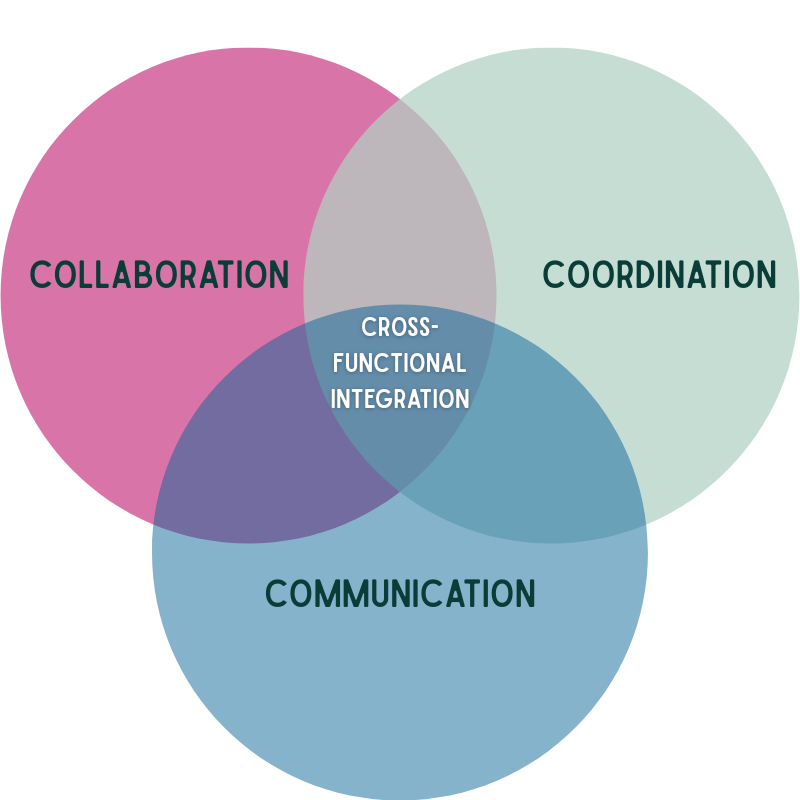
Collaboration is the capacity to work with peers toward a shared goal. It keeps teams aligned on priorities and prevents work from stalling simply because another department is usually responsible for it. Teams that collaborate well often trust one another to complete the tasks assigned to them by the deadline, innovate creative solutions by leveraging their diverse perspectives and knowledge bases, and openly provide feedback and opinions to one another when partnering on shared work.
Coordination includes the day-to-day execution skills that turn ideas into outcomes, such as people management, time management, workload planning, and the ability to sequence work across teams. Strong coordination habits are often what keep cross-functional initiatives from drifting or stalling.
Communication is the skill that brings it all together. It includes the ability to express ideas clearly, persuade others by articulating reasoning, and share context in a way that enables informed decision-making across stakeholders. When communication is strong, information moves through the organization, dissolving departmental knowledge silos.
Research from McKinsey reinforces the specific skills required to successfully integrate as a unit. Their 2024 findings show that trust, communication, innovative thinking, and decision-making are four of seventeen key behaviors involved in integration and the ones most strongly linked to high-performing teams. Teams that excel in these areas are more efficient, innovative, and effective in meeting stakeholder needs.
A 2025 literature review also found that cross-functional collaboration is one of the strongest predictors of project success, especially in environments where teams must work across silos.
When employees can successfully integrate their knowledge across areas of the business, you get fewer bottlenecks, faster problem solving, and a much smoother experience for both your team and your clients.
Thankfully, the research also shows that not only are the cross-functional integration skills critical for optimizing the growth of your organization, but they can and should be taught to your team on the job.
How to Teach These Skills Inside Your Organization
Developing integration capabilities does not require restructuring or sending people back to school. It requires intentional design and consistent practice within existing roles.
Below are several evidence-aligned ways to strengthen these skills inside small teams.
1. Use Real Cross-Functional Work, Not Just Training
Cross-functional integration skills are best developed through application, not theory. Organizations should give employees structured opportunities to work across departments or roles, especially at junior levels.
Examples:
Assign employees to small, cross-functional project squads
Rotate team members into temporary “boundary-spanning” roles
Pair early-career staff with experienced cross-functional mentors
Provide opportunities for employees to cross-train across functions
This mirrors how business schools improve these skills through experiential learning.
2. Build Coordination Habits, Not Personality Traits
Coordination is a learned integrating resource, not an innate talent. The most effective organizations build shared habits that make coordination an everyday practice.
Examples:
Standard project planning steps
Clear owners and timelines
Workload visibility across teams
A consistent definition of “done”
A single source of truth for project info
These habits reinforce time management and prioritization, which employers consistently rank as top coordination skills.
3. Create Communication Playbooks for Cross-Team Work
Communication is often the largest perceived gap, but it is also the easiest to standardize. Organizations can reduce this gap by giving employees clear templates and scripts for communicating across functions.
Examples of helpful tools:
Weekly group update meetings
Templates for kicking off shared project work
Shared language around urgency, expectations, and dependencies
Communication flowcharts
These help prevent information silos and support reciprocal communication, which studies highlight as central to effective cross-functional integration.
4. Clarify Context: Teach Employees How the Business Fits Together
Understanding the business as a system strengthens all three cross-functional integration skills. Employees collaborate and coordinate more naturally when they understand how each function fits into the big picture of the business.
Examples of ways to do this:
Internal “How Our Business Works” briefings
Shadowing across teams
End-to-end process maps
Department-led lunch-and-learns
This ensures employees at all levels of the organization do not lose sight of how each function contributes to collective goals.
5. Create Shared Accountability for Integration
Organizations can build cross-functional expectations into all roles by encouraging a collaborative culture and holding employees accountable through documented reviews and feedback.
Examples of ways to do this:
Competency frameworks that include collaboration, coordination, and communication
Performance reviews that measure shared outcomes
Reward systems for teamwork, not only individual achievements
Providing clear role expectations up front, which include shared accountability for cross-functional work, will ensure all team members feel responsible for the group’s success.
Cross-Functional Skills Are Growth Infrastructure

Businesses that commit to professional development of communication, collaboration, and coordination capabilities through intentional, hands-on projects do more than just improve employee skills. They actively strengthen the company’s ability to grow.
If you have a small, agile team that has become increasingly dependent upon key players to work well across the organization, you should consider a plan to dissolve their functional silos by enhancing their team dynamics through clear expectations, ensuring that reliance on key individuals transitions into reliable, scalable team processes.
Investing in these opportunities ensures your team can operate as an integrated unit and gives your organization the internal infrastructure it needs to succeed.
Next Steps: Solve Your Silo Problem
You’ve identified the root cause of your growth friction: a lack of cross-functional integration. The shift from individual expertise to a cohesive, coordinated unit requires intentional structure.
If your growing business is struggling with broken handoffs and coordination gaps, let’s discuss how your current processes measure up against the needs of sustainable growth.
Click here to schedule a free 15-minute introductory call with Tiffany Dougherty, the author and founder of Streamline Strategies.
We’ll use that time to explore where your biggest integration opportunities lie and how we can design the internal infrastructure your team needs to scale seamlessly.
Here are a few other ways to stay connected:
About the Author
Tiffany Dougherty is the Founder and Principal Consultant of Streamline Strategies, LLC. At Streamline Strategies, she helps businesses align their people, processes, and platforms so they can grow sustainably and serve their clients with confidence. She draws on more than 13 years of leadership experience in strategic operations and customer success to help B2B service companies scale sustainably with people-centric operations.