How to Stop Hiring at the Last Minute
On paper, your business is a success story. You’ve got a strong team, revenue is scaling, and cash flow is healthy enough that you don’t have to hold your breath when you open your bank app in the mornings.
In reality? Your team is fried to a crisp and you have three new customers onboarding next week. You know you need to scale the delivery team, but the thought of vetting and hiring rapidly makes you feel physically ill. Your hiring process is just an Indeed post and a spreadsheet. Every open role is another list of responsibilities you have to either absorb yourself or scramble to hire for.
So, you do the logical thing to keep this from happening again: You hire an HR professional.
You figure a leader dedicated to helping you get new people in the door will solve at least half of your problems, and eventually you’ll get to offload your growing to-do list.
But a few months later, you realize you didn’t get to hand off as much work as you expected. Your new HR Manager is a rockstar at recruiting and hiring, but you are still the one responsible for deciding when to hire, determining which roles to fill first, setting expectations, and covering execution gaps while the new hire gets up to speed.
It turns out your scaling bottleneck isn’t money, demand, or HR headcount. It’s the absence of a stable hiring system that integrates hiring into the way work, revenue, and delivery are planned and executed.
How Hiring Becomes the Bottleneck
When hiring is reactive instead of planned, it amplifies the stress it was meant to relieve. And if your company’s growth outpaces its ability to attract the necessary talent, it can lead to overworked employees, lower service quality, and ultimately a bottleneck that puts a limit on further expansion.
When you and your team are simultaneously trying to serve clients, generate revenue, complete strategic initiatives, and build your organization’s capacity for future growth, there’s a limit to how much can realistically get done well.
Top candidates usually (in the best of times) go off the market within two weeks. The average time to fill a role is over 40 days. By the time you need someone, post the role, conduct interviews, and extend an offer, you’re going to be drowning in work. Then add on another 2-5 months before they’re really contributing to the team meaningfully. The gap between realizing you need help and actually getting it is where teams usually burn out.
If you’ve hired HR to be a dedicated resource for expanding the team, you have removed from your personal to-do list many aspects of the complex process of recruiting, interviewing, hiring, onboarding, and training.
But it is not the HR Manager’s job to create the strategic framework for when to hire, which roles to fill, or how those new people become productive without derailing delivery. It’s your role, as leader of the organization, to build organizational infrastructure that HR can follow to get the hiring and onboarding done by the time you need those bodies executing.
You have to proactively integrate hiring planning into your operating rhythm. Hiring is done best when plans for it are made alongside revenue forecasts and delivery commitments.
What Happens When You Hire Without Systems
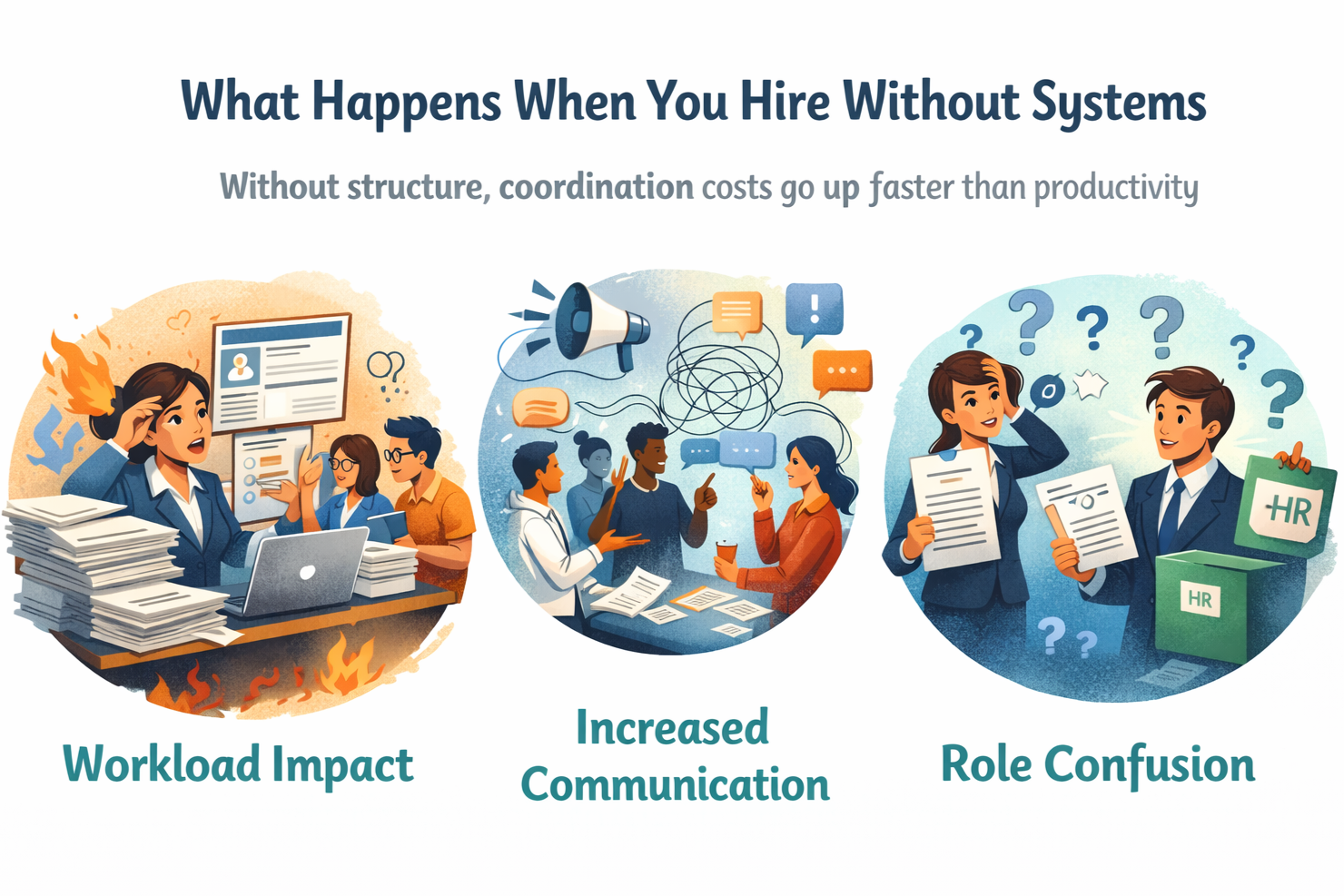
If you ignore this advice and hire without first taking the time to create a hiring engine, or system for this process, you’re going to run into a few challenges. The problems below all stem from the same root issue: without structure, adding people increases coordination costs faster than productivity.
Workload Impact
New hires need to learn a lot in a very short period of time. Without structures in place to automate training, explain detailed processes, or demonstrate your tools, your existing team has to stop what they’re doing to train them. That could mean days or even weeks of doing their normal job and hosting training sessions, which would push them even closer to burnout.
Increased Communication
Adding new people to your team expands the number of communication pathways within your organization. If you don’t have set processes for how roles work together, they have to figure out on the fly.
Role Confusion
If leadership hasn’t defined the role and how it will fit into the organization, HR is just hiring to hire. How will the role impact delivery? What is this person responsible for? What deliverables are they accountable for? What do we need to make sure they know? So many questions with nowhere to look for an answer.
HR can be absolutely amazing at hiring and onboarding, but if they aren’t equipped with the tools and information they need, they won’t be able to train and onboard them without asking you for help.
If you and your team are already operating at close to 100% capacity, your business is going to slow to a crawl. Implementing a clear process for hiring is the only way to smoothly absorb new hires into the system without disrupting delivery.
The Missing Pieces
Building a hiring engine means integrating hiring into your business operating system. In my experience, there are four essential components: proactive capacity planning, clear decision architecture, a repeatable hiring process, and a structured onboarding guide.
How you create these will depend on the specifics of what your organization and team need and the services you offer, but I will provide a high-level overview of the essentials to get you started.
Capacity Planning
(Leadership-owned)
Capacity planning works when it looks ahead instead of reacting to pain. This is the foundation that tells you when to hire.
Clear demand signals
Use forecasted revenue, signed work, and pipeline to anticipate when additional capacity will be needed, not just when the team is already overwhelmed.
Baseline capacity definitions
Define what a full workload looks like by role using real data from current clients, projects, or service volume so future projections are grounded in reality.
Ramp-up assumptions
Account for the time it actually takes a new hire to become productive so capacity is modeled based on when help arrives, not when someone starts.
Trigger thresholds
Set agreed-upon capacity or utilization levels that initiate hiring conversations before delivery quality or team health deteriorates.
Leadership ownership
Review capacity and demand together during planning cycles so hiring decisions are made deliberately, not escalated under pressure.
Example: The Trigger for More Project Managers
A SaaS implementation team determines that one Project Manager can effectively handle 10 active onboardings (Baseline Capacity). Knowing it takes ~60 days to find a hire and 30 days to ramp them (Ramp-up Assumptions), they don’t wait for 10/10 capacity. Instead, they set up a trigger threshold. When the sales pipeline shows a 70% probability of 5 new deals closing next month (Demand Signals), HR is automatically authorized to post the role.
Clear Decision Architecture
(Leadership defines, HR executes)
Hiring slows down when no one is clearly empowered to act. Decision Architecture allows for seamless delegation with clear guardrails.
Decision ownership by level
Define who can approve roles, headcount, and offers at each level so hiring does not stall waiting for executive involvement.
Delegated budget authority
Give managers spending authority within reasonable limits so compensation and role approvals do not need to be re-negotiated every time.
Speed versus quality trade-offs
Decide in advance when it is acceptable to prioritize speed over perfection so teams are not debating risk mid-hire.
Escalation rules
Clarify when decisions must move up the org chart and when they should not, reducing unnecessary bottlenecks.
Leadership design, not execution
Leadership defines how decisions flow, rather than personally participating in every hiring decision.
Example: Getting a Quick Green Light
To avoid the “Let me check with the CEO” bottleneck, a company establishes a hierarchy of authority. Department Heads are pre-approved to hire any role already in the annual budget (Delegated Budget) created off your forecast. HR is empowered to extend offers immediately if the salary is within 5% of the midpoint (Decision Ownership). Only “Out-of-Budget” or “C-Suite” roles require an escalation to the Founder (Escalation Rules).
Repeatable Hiring Process
(Leadership defines, HR executes)
A repeatable process prevents every hire from feeling like a brand-new project.
Role and level clarity
Standardize role expectations by level so job descriptions and hiring criteria are consistent and aligned to delivery needs.
Structured evaluation
Use interview scorecards and consistent questions so candidates are evaluated on outcomes, not gut feel.
Clear decision criteria
Define what qualifies as a “yes,” “no,” or “needs more data” to prevent drawn-out hiring cycles.
Process visibility
Ensure there is a centralized source for tracking hiring progress, so everyone involved knows where candidates are in the process at any given time.
HR-led execution
Once the framework exists, HR can run hiring efficiently without constant leadership clarification.
Example: The Scorecard Shift
Rather than asking “So, tell me about yourself,” every interview uses the same four situational questions mapped to a 1–5 scale (Structured Evaluation). The “Decision Criteria” is set in advance: a candidate must score at least a 4 on “Communication Skills” and “HubSpot Experience.” Because the criteria are clear, HR can move a candidate to the “Offer” stage without the founder needing to “hop on a quick call” to review the interview notes.
Structured Onboarding Plan
(Built with HR, owned across the organization)
Onboarding only works when it is treated as real work, not an afterthought.
Pre-boarding readiness
Ensure tools, access, and equipment are ready before day one so new hires can contribute immediately.
Role clarity and expectations
Clearly outline what success looks like in the first 30, 60, and 90 days so new hires are not left guessing.
Learning paths and enablement
Sequence training so new hires learn what they need first, without overwhelming them or interrupting the team. Don’t forget to schedule breaks for completing paperwork and processing information!
Ownership by function
Ensure everyone has a clear role so each function knows what to expect and one person doesn’t have to do everything. Managers own role training, teams provide context and shadowing opportunities, HR coordinates timelines, and operations enable access, etc.
Capacity accounted for
Plan for onboarding effort in capacity models so training time does not overload existing staff. Their work won’t slow down just because you’re doing onboarding.
Example: The 30-60-90 Onboarding Roadmap
Instead of a new hire deciding to shadow a busy veteran on a random Tuesday in order to “pick things up,” their manager receives a 90-day checklist and schedules meetings for them before they ever start. The existing team doesn’t burn out because the new hire’s training is a scheduled project, not an unexpected distraction from their daily work. The new hire understands from the start what they will be expected to learn and by when.
TL;DR Courtesy of ChatGPT
When to Build & Hire
The right time to build hiring infrastructure is earlier than most leaders expect.
The most critical pieces are the ones that help you decide when hiring should happen at all, and they should be built as early as possible: basic capacity planning, realistic ramp-time assumptions, and clear trigger points tied to forecasted demand. Those are leadership-owned and can be built incrementally, long before you are ready to post a role.
Decision architecture, the hiring process itself, and a structured onboarding plan can come later, often in partnership with Operations and HR hires, once the business is clear on what roles are needed and why.
If you wait until the team is already overwhelmed with delivery to build any of this, you will not have the time or attention required to design the systems that allow a new hire (or an HR Manager) to succeed.
Here’s the other part that often feels backwards: growth does not create the space to build systems. Systems are what create the space for growth. Without them, demand simply consumes whatever capacity exists.
Once you have those foundations in place, you can wait to actually hire until the business has enough financial stability to support another salary, but before your team gets stretched too thin. This is often the moment when the business looks like it’s thriving from the outside, but only because you and your team are working overtime to make it happen.
Hiring early can feel like the wrong move if you are someone heavily focused on the bottom line (aka literally any founder ever). You are taking a calculated risk that demand will materialize as expected, and there is always a chance that your forecast will not fully come to fruition. In that case, you may have to make a hard call later.
At the end of the day, it is still your call. And if you believe your forecast is credible and you would rather staff your team proactively than scramble under pressure later, building early is the responsible choice.
The businesses that scale smoothly (or, at least more smoothly!) invest in structure when they can still think clearly and make hires proactively, not when they are already underwater.
From Functional Hire to Structural Design
When hiring feels like a burden, I can understand the instinct to hire HR to help you get more bodies in the door.
And to be clear, hiring HR is often the right move. Skilled HR professionals bring expertise, consistency, and care to a process that is critical to the business and the people that run it. But HR cannot design the operating conditions that make hiring work. That responsibility sits with leadership, and you as the founder.
Scaling your organization goes much more smoothly when you have structures that objectively indicate when to hire, who decides, how people get onboarded, and how new capacity is absorbed without breaking delivery. Without that structure, every hire adds short-term strain before they can contribute long-term value.
When you design the system first and then bring in the people who can run it well, you build an environment that is flexible enough to scale on demand without burning out your best people or yourself.
At Streamline Strategies, I help businesses align their people, processes, and platforms so they can grow sustainably and serve their clients with confidence.
If you’d like ongoing support, here are a few ways to stay connected: